Key Points
- Campbell Soup cut its quarterly dividend to 25 cents, creating a more sustainable payout with a forward yield of about 4.7% while it works to reduce debt.
- Technical signs suggest CPB shares may be forming a bottom near the low $20 range, supported by high short interest and steady institutional accumulation.
- Weak consumer demand pushed Campbell to lower its outlook, forecasting a 3% organic revenue decline, though analysts largely maintain Hold ratings with an $18 price floor.
The Campbell's Company (NYSE: CPB) has reset its dividend, and the move gives investors a cleaner way to judge the stock: the payout is now more sustainable, but the turnaround still has to deliver. While investors hoped for the best, thinking the brand and balance-sheet strength could sustain the payout until turnaround efforts took hold, cash flow didn’t cover the payment, and debt ballooned. This is reflected in the price action: CPB shares shed 60% in the preceding quarters as the market priced in the risk, if not the reality.
Campbell’s new dividend is lower, but it is also easier to defend. The 25-cent quarterly payout gives the stock a forward yield of about 4.7% at recent prices, which remains attractive for a consumer staples name. Shares also trade at a modest forward earnings multiple, suggesting much of the bad news may already be reflected. More importantly, the reset brings the payout back to a more manageable level, giving Campbell’s more room to absorb weakness, reduce debt and fund its turnaround.
Benefits of cutting distributions are immediate, including approximately $170 million in annual cash flow that can go directly toward debt reduction. Catalysts include plans for up to $500 million in cost savings that will free up future cash flow, enabling accelerated debt reduction, equity gains, and capacity for capital returns.
Campbell’s Downtrend Is Ending
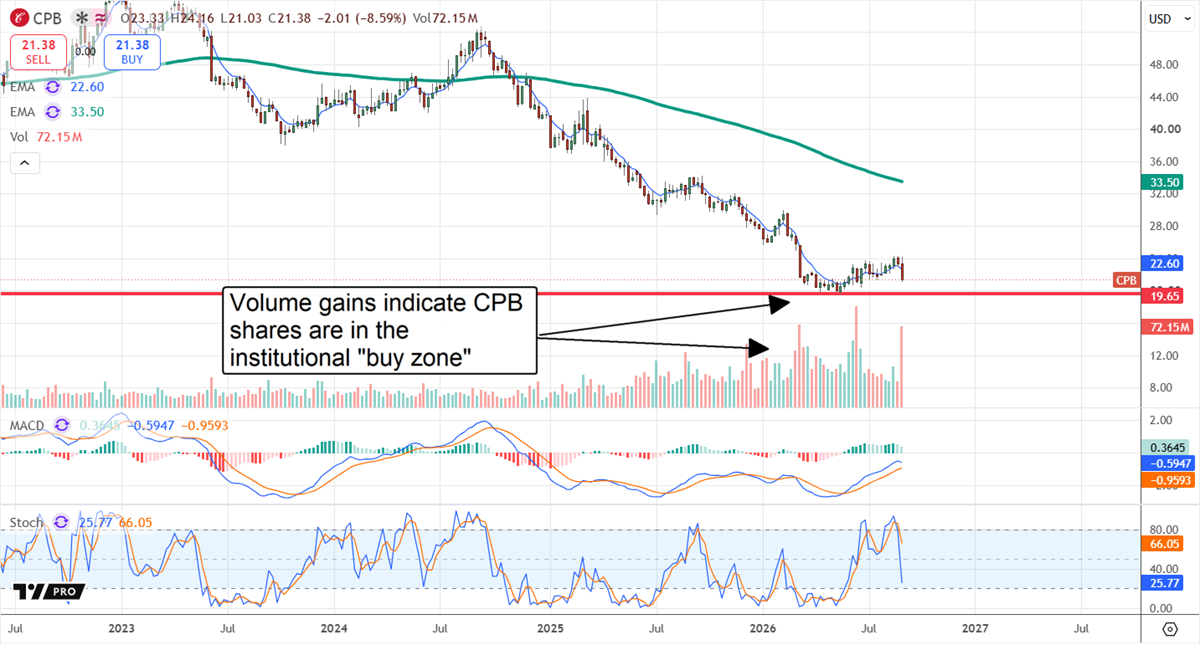
Campbell’s downtrend may not be over, but the signs of a bottom continue to strengthen. While price action declined by more than 8% during the week of the cut, it failed to set a new low or even approach the existing low, suggesting buyers remain within the range. Additionally, a volume spike aligns with trends revealing aggressive accumulation at solid support in the low $20 range.
The likely outcome is that CPB retests the existing lows, if it even moves that low, before rebounding within its range. In this scenario, CPB shares are at the bottom but likely to trend sideways until it reflects tangible turnaround results. When that happens, upside may be robust, because the short interest is phenomenal. As of early September, CPB is among the most shorted blue chips, with interest in the high teens.
Campbell's Suffers From Consumer Habits
Campbell's didn’t have a terrible quarter, but it wasn't good, with results showing organic sales down 1% in both volume and mix, compounded by an extra week in the prior year. The main hurdle is consumer habits: lower-income shoppers are turning to cheaper, private-label brands, and higher-end consumers are shifting to fresh or protein. The worst of the news is the impact on the outlook, which was cut alongside the dividend. Management forecasts a weak year, with organic revenue expected to decline by 3% and margins to compress.
Analysts were not pleased and lowered price targets after the release. However, even with sentiment pegged at a consensus rating of Reduce, though the breakdown is more neutral than that label might suggest: 13 of the 19 analysts tracked rate the stock Hold, while six rate it Sell. The average price target sits below the current share price, though the $18 low target remains near the stock’s recent support zone. CPB may push to a new low, but it will likely trigger a buying signal if it does. Institutions have been taking advantage of CPB's low share price, accumulating quarterly throughout the downturn, and accelerating activity in early Q3.
The biggest risk for CPB investors is the timing of turnaround signals. The base-case scenario is that price action moves sideways indefinitely, but a catalyst is expected within the upcoming quarters. The best-case scenario is that turnaround efforts gain traction quickly. Campbell’s has a healthy portfolio of loved brands outside its soups, including Rao’s, V-8, Goldfish, and Cape Cod chips, so there are growth levels to pull. The worst-case scenario is that consumer headwinds worsen or executive missteps emerge, leading to lower stock prices before the rebound and recovery begin.
Other reasons to buy CPB include a cyclical recovery in consumer staples stocks. The sector is trading near long-term lows and at the low end of historical price-to-earnings (P/E) ranges, setting it up for a substantial recovery. It will take time, but buy-and-hold investors can expect a return to quarterly growth in the coming year for most in the sector, including Campbell's, and growth-driven gains that lead to higher P/E multiples over time. Trading near 12.5x earnings, CPB can advance by 60% on valuation metrics alone, and that’s just to the historical average. An earnings recovery could push this stock to the high end of its P/E range and add another 4000 basis points to the forecast, in addition to the dividend.
Get Income-Generating Stocks Like Campbell's in Your Inbox.
Stop riding the roller coaster of the stock market and sign-up to receive DividendStocks.com's daily ex-dividend stocks and dividend investing news for CPB and related companies.
Companies Mentioned in This Article:| Company | Current Price | Price Change | Dividend Yield | P/E Ratio | Consensus Rating | Consensus Price Target |
|---|
| Campbell's (CPB) | $20.73 | -2.5% | 4.82% | 9.80 | Reduce | $19.88 |

About Thomas Hughes
Experience
Thomas Hughes has been a contributing author for DividendStocks.com since 2019.
- Professional Background: Thomas Hughes is the Managing Partner of Passive Market Intelligence LLC, a market research platform he launched in 2023 with the mission: “We watch the market so you don't have to.” He has worked as a blogger, stock market commentator, and independent analyst since 2010 and has been actively involved in trading and investing since 2005.
- Credentials: He holds an Associate of Arts in Culinary Technology—training that honed his discipline, attention to detail, and ability to anticipate outcomes, all of which carry over into his work as a market analyst.
- Finance Experience: Thomas has been writing about finance and investing since 2011, when he discovered it could be more than a personal passion—it could be a profession. He’s been a contributing writer for DividendStocks.com since 2019.
- Writing Focus: He specializes in the S&P 500, small-cap stocks, dividend and high-yield strategies, consumer staples, retail, technology, oil, and cryptocurrencies. His analysis blends chart-based technical setups with key fundamental insights, helping readers identify actionable trends.
- Investment Approach: Thomas takes a hybrid approach that combines technical analysis with deep fundamental research. He often writes about macroeconomic shifts, earnings trends, and sentiment-based trading signals.
- Inspiration: Thomas first became interested in stocks after attending a seminar on how to buy and sell your own shares. That event opened his eyes to the market's potential and sparked a lifelong interest in investing.
- Fun Fact: Thomas took up model railroading by accident a few years ago—and now he can’t stop running the rails.
- Areas of Expertise: Technical and fundamental analysis, S&P 500, retail and consumer sectors, dividends, market trends
Education
Associate of Arts in Culinary Technology